Digging Deeper
by Center for Science and Culture
Proof of God in 3 Minutes demonstrates how the scientific Law of Conservation of Matter and Energy points to the need for a “supernatural” first cause of the universe. While the video is designed to simplify key concepts, for those interested in digging deeper, we are providing additional information in this article. This article will demonstrate that this video is accurate, well-supported, and there is truly no serious argument against its conclusions.
What is a Law of Science?
A “Law” of science is a statement that captures an empirical observation that the universe always obeys. If a contrary observation were ever made, it would lose its designation as a law.
The Scientific Law under Discussion: The Law of Conservation of Matter & Energy
The video begins by describing a natural law — “the law of conservation of matter and energy” (0:10), which is also known as the first law of thermodynamics. It states that “matter and energy cannot be created or destroyed” (0:16). This law falls into a category of laws known as “symmetry laws.” In this instance, the symmetry1 applies to matter/energy across an equal sign that separates time points.
Matter + Energy at time X = Matter + Energy at time Y
If you are wondering why the law refers to both matter and energy, it is because matter is equivalent to energy based on Einstein’s most famous equation, E = mc². In that equation, the variable “E” stands for the “energy” associated with “matter” of mass “m.” An intuitive example of that would be burning wood — the piece of wood becomes a smaller mass as it gives off light and heat energy. The wood mass converts to light and heat energy.
On a subatomic level, we see that if a subatomic mass (e.g., an electron having one unit of negative charge) collides with its antiparticle (a positron, which is identical to an electron but instead has one unit of positive charge), the two annihilate (neutralize each other), yielding two gamma ray photons (two quanta of electromagnetic energy released in opposite directions). The particle masses convert to energy.
Taking this concept back to E = mc², the generated photons have a combined energy (E) equal to the combined masses (m) of the two original particles times c2, where the variable “c” is the speed of light. Conversely, two photons of energy (E) can convert into a particle-antiparticle pair with a combined mass (m) equal to E/c². This interchangeability of energy and matter is why the Law of Conservation of Matter and Energy refers to both matter and energy.
For simplicity, the video sometimes references only matter, rather than the interchangeable combination of mass and energy (also known as mass-energy). For the same reason, physicists often refer to this conservation law as simply the Conservation of Energy or Conservation of Matter. For the rest of this article, we will refer to this interchangeable form in the same way — when we refer to matter or energy alone, we are referring to both matter/energy.
Matter Cannot Be Created or Destroyed.
While interchangeable, the fact that matter/energy cannot be created or destroyed is a foundational concept in physics today. Applying this natural law indicates that our universe will not gain or lose matter/energy by any natural phenomenon. Matter/energy must be constant. Many articles on the subject describe it as: “However much energy there was at the start of the universe, there will be that amount at the end.”2
In fact, in applied science, this law is fundamental to cutting-edge research. For example, the largest machine in the world is the Large Hadron Collider (LHC),3 which accelerates subatomic particles to near light speed and then smashes them together to catch the scatter. The LHC relies on the Law of Conservation of Matter and Energy, using the same equation we previously discussed.
Matter + Energy at time X = Matter + Energy at time Y
By measuring the pre-collision particle matter/energy (at time X) against the post-collision debris scatter products of matter/energy (at time Y), the LHC investigators can ensure they have found all the scattered matter/energy of the larger original particles. This is precisely how the Higgs Boson (also known as the God Particle) was first detected at the LHC. The Higgs Boson was a scattered post-collision decay product.
The Symmetry Equation points to a supernatural phenomenon.
This concept of conserving matter/energy based on a starting point leads to a glaring problem. The Law of Conservation of Matter and Energy requires that:
Matter + Energy at time X = Matter + Energy at time Y
But where did the first matter/energy come from at time X to begin the equation?
Writing this a different way:
Nothing at time X = Matter + Energy at time X
The Law of conservation of matter/energy answers this question by indicating “nothing natural could have done this.” Something cannot come from nothing.
Somehow, the Law of Conservation of Matter and Energy was circumvented at the beginning of the universe, defying the Law of Conservation of Matter and Energy.4 Put simply, there would be no universe if only natural processes were at play. There should be no matter/energy at time X, and so at time Y (which is right now) there should be no universe of matter/energy. There should be “Nothing!”
What is Nothing?
The maxim “Nothing comes from nothing” is the simplest form of the symmetry equation and law we have been discussing. So how could something come from nothing and circumvent the law? We must start by comprehending “nothingness” as scientists.
In the time of Plato, “nothing” was what you find in an empty cup. Today, we know that an empty cup contains many things, including gas molecules, atoms, electrons, protons, energy in the form of temperature, energy in the form of light photons (when the lights are on), etc. Even the less-intuitive space-time fabric of the universe is in that cup.
The Proof of God video states that “we have never seen matter come from nothing” (2:18) and rejects the idea that virtual particles can “pop out of nothing” (1:54). The “nothing” the video is scientifically referring to is “Absolute Nothing” — the modern understanding of true nothing.
What is “Absolute Nothing?”
At first glance, grasping “Absolute Nothing” might seem easy, but it is challenging and rather mesmerizing.
“Absolute Nothing” is characterized by the complete absence of heat, light, and sound, and it may surprise the reader that despite our many modern marvels, there is no known way to reach “Absolute Nothing.”
Is it significant that we cannot achieve “Absolute Nothing?”
Yes! The fact that we have no way of achieving “absolute nothing” is itself a powerful foundational concept. Stated clearly: We cannot create an instance of nothing.
This foundational concept sets up a simple retort to any scientist who falsely states “something can pop out of nothing.” The simple and powerful retort is: “When was the last time you saw something come from nothing if we cannot even get to nothing to begin with?”
And yet, certain popular atheist physicists have made this remarkably false “Something from Nothing” statement, though they never achieved nothing as a starting point.
This broken-logic argument is captured in the book A Universe from Nothing written by Lawrence Krauss (an admittedly entertaining atheist physicist). In his book, he concedes that “Nothing is Something” (this is actually the title of chapter 9).
He writes: “First, I want to be clear about what kind of ‘nothing’ I am discussing at the moment. This is the simplest version of nothing, namely empty space.” He then defines empty space by saying: “Empty space can have a non-zero energy associated with it…” He then states “…empty space endowed with energy can effectively create everything we see…” (emphasis added). And finally, Krauss confesses “…it would be disingenuous to suggest that empty space endowed with energy…is really nothing.” So Krauss effectively concedes that he cannot achieve his misrepresented starting point of Nothing. Therefore, his book “A Universe from Nothing” is falsely titled.
Krauss tries to get around the Law of Conservation of Matter and Energy by redefining nothing so that we have energy to start with. Writing it mathematically would look like this:
Nothing + Energyat time X = Matter + Energyat time X
But that equational sleight of hand is so obvious that even Krauss had to admit that “…it would be disingenuous to suggest that empty space endowed with energy…is really nothing.”
Lawrence Krauss’s Book is worth reading — or at least Chapter 9 (“Nothing is Something”)
For anyone who wants to know why “Proof of God – in 3 Minutes” is correct, go to the most ardent opponent’s own writing. It is actually a confession that points to a supernatural act.
Using Krauss’s own words in “A Universe from Nothing” (Chapter 9): “Of course, supernatural acts are what miracles are all about. They are, after all, precisely those things that circumvent the laws of nature.” (emphasis added)
Krauss resorted to “word-play” by entitling his book A Universe from Nothing and then entitling chapter 9 “Nothing is Something,” which by simple replacement makes the title of his book tantamount to “A Universe from Something.” Unfortunately, not everyone makes it to Chapter 9, where Krauss also states, “…it would be disingenuous to suggest that empty space endowed with energy…is really nothing.”
His broken argument is a logic journey attempting to find a way around the conservation of matter/energy — hoping to create matter/energy from nothing. But even he confesses he cannot get around it.
Not everyone makes it to chapter 10 either (Nothing is Unstable) in which Krauss (using his admittedly disingenuous definition of nothing), states: “Nothing always produces something, if only for an instant. But here’s the rub, the conservation of energy tells us that quantum systems can misbehave for only so long.” (Emphasis Added)
If Krauss really meant “Absolute nothing always produces something” our question to Krauss (as previously described) would be: “When was the last time you saw something come from nothing if we cannot even get to nothing to begin with?
But that is not what Krauss’s “nothing” means. He already confessed that. He means “Nothing endowed with Energy” – well, we have seen that – we just call it “Something.”
Wordplay sells books, but also cheats readers. Most readers misplace their trust in Krauss, who sells science fiction in the form of non-fiction, and has misled multitudes with his entertaining style and abused credentials.
Still, we recommend that you buy his book and read it from cover to cover (or at least Chapter 9). If this is the best argument even an ardent atheist physicist can make to get around the Law of Conservation of Matter and Energy, surely it provides validation for the simple video truths in “Proof of God – In 3 minutes!”
How does the Law of Conservation of Matter and Energy interrelate with the Big Bang Theory?
If you type WMAP into your search engine, you will likely end up at the NASA Wilkinson Microwave Anisotropy Probe page. On that page you will find the image that is labeled Figure 1 below. This depiction of the universe’s history was determined by the data from the probe (aka satellite), which is labeled WMAP on the right side of Figure 1. From left to right is a timeline showing the expansion of the universe, as measured by the probe (using the Cosmic Microwave Background Radiation–CMBR). The timeline of 13.77 billion years is the “apparent” time it took to get from an unexpanded state of matter (on the left side of the image) to the current expanded state of matter (on the right side of the image). The word “apparent” is meant to say that no one really knows factually how much time this took. We can only “infer” based on the current expansion rate and the temperatures of the CMBR of approximately -270°C (three degrees warmer than absolute zero, which is -273°C).
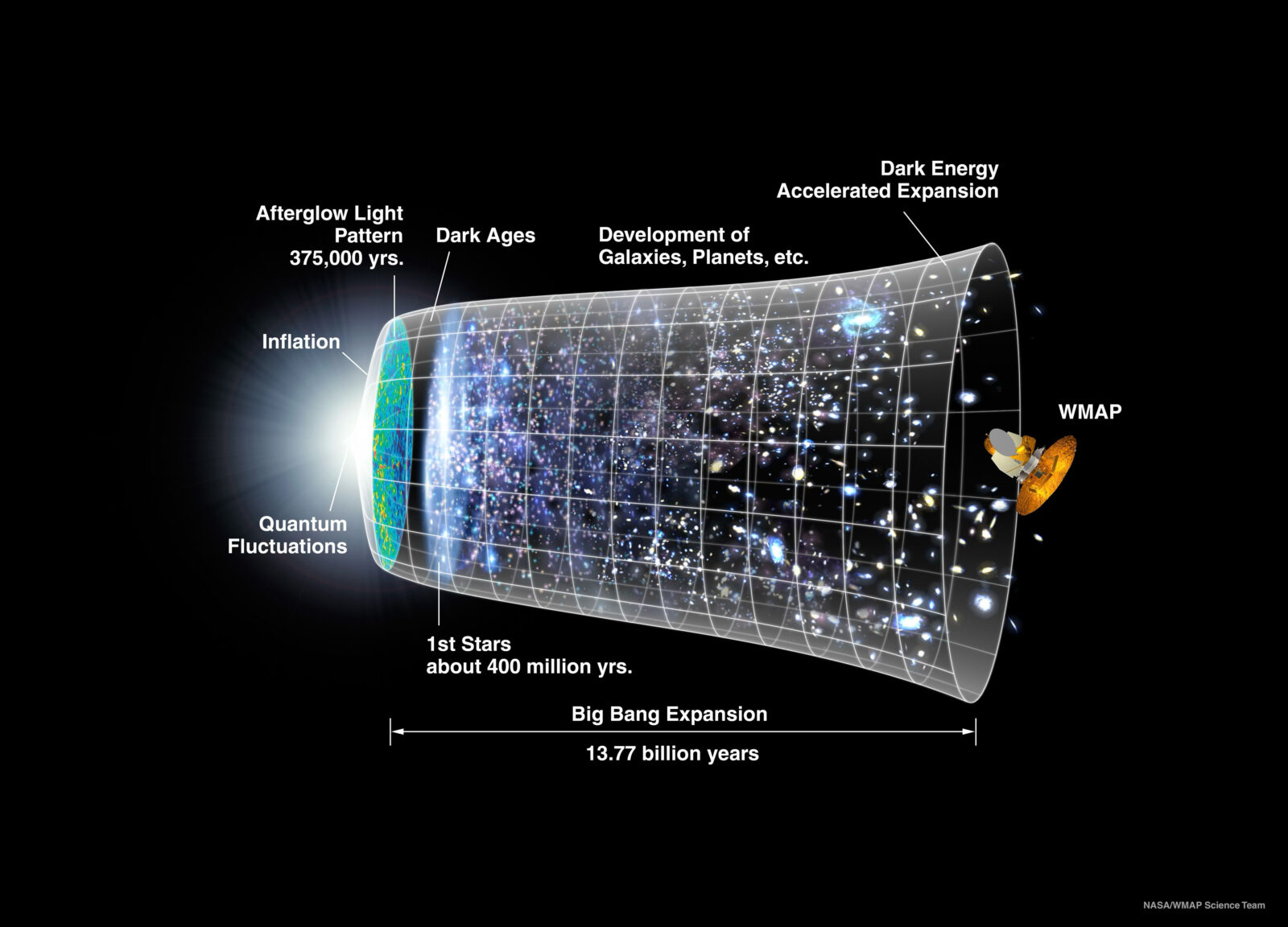
The main takeaway from this image is that the universe’s matter/energy originated from a single point, however long ago that was!
First Cause: How WMAP’s evidence for a single point of origin relates to the Law of Conservation of Matter /Energy—and points to a First Cause
On the far-left side of the WMAP figure (Figure 1) is blackness. There is no light, no heat, no sound, no matter, and no energy. That is, there is no universe. As previously described, this is “Absolute Nothing.” This point on the Figure 1 timeline, the precipice of Absolute Nothing crossing into all the matter in the universe, occurs approximately in the area labeled “Quantum Fluctuations.”
There is only one problem, quantum fluctuations only occur in an already existing energy field. So the point labeled “quantum fluctuations” is actually a violation of the Law of Conservation of Matter and Energy.
This “quantum fluctuation” placeholder is a well-known problem, and here is how Lawrence Krauss deals with it in A Universe from Nothing. Krauss writes:
“These ’quantum fluctuations’ imply something essential about the quantum world: nothing always produces something, if only for an instant. But here’s the rub, the conservation of energy tells us that quantum systems can misbehave for only so long.” (emphasis added)
To put Krauss’s point another way, any particle-antiparticle pair that appears will quickly disappear; they are not permanent.
Of course, as previously quoted, Krauss’s use of the word “nothing” (he repeatedly confesses) is “empty space endowed with energy.” From that pre-existing energy field, of course, quantum fluctuations can occur, but they cannot (as his previous quotation admits) violate the Law of Conservation of Energy. Quantum Fluctuations do not create anything — Krauss admitted this.
So this brings us back to the question of First Cause, depicted again below as:
Nothingat time X = Matter + Energyat time X
Krauss’s prior quote (above) referencing the conservation of energy confesses this is a violation of the Law, and it corners him into the following quote: “The apparent logical necessity of First Cause is a real issue for any universe that has a beginning. Therefore, on the basis of logic alone one cannot rule out such a deistic view of nature. But even in this case it is vital to realize that this deity bears no logical connection to the personal deities of the world’s great religions, in spite of the fact that it is often used to justify them.”6 (emphasis added)
As previously noted, remarkably Dr. Krauss’s book is an atheist physicist’s confession that belief in a deity is logical. His atheism appears to merely reject the world’s great religions — even while he admits “this deity” is logical.
The Counter-Arguments
The video states that “there really is no serious scientific argument against this” conclusion (2:27) and that whatever circumvented the Law of Conservation of Matter and Energy at the beginning of the universe was “supernatural.” (2:45)
The video deals with the two main objections. Below we offer more:
Objection 1: That Law May Be Proven Wrong One Day (1:30)
This objection is an argument fallacy known as the “Argument from Ignorance.” While all science is provisional and subject to new discoveries, arguing against a law (an empirical observation that the universe always obeys) with the unsupported expectation that it will be demoted one day is illogical because there is no reason to believe this will happen.
As the video states, “maybe one day” (1:34) these arguments may be proven wrong, “but as of today it is a law and it’s considered one of the most foundational laws of physics” (1:40). The video then properly reasons that these types of objections are guilty of “avoiding today’s scientific reality” (1:45).
Objection 2: The Law May Not Apply to Cosmological Physics
This objection argues that the physics of cosmological origins (i.e., the Big Bang model) may involve conditions where the Law of Conservation of Matter and Energy is not valid or applicable, or that the beginning of our universe might emerge from some deeper physics that is not yet understood, or that the law may not apply throughout the entire universe.
While rational reasoning must always leave room for possibilities (even if it is just conjecture), rational reasoning relies on following the evidence itself (not the un-evidenced alternative). This is particularly true when the evidence has been established as universally empirically true — i.e., a scientific law.
So this objection is really a variation of Objection 1.
Interestingly, even theoretical cosmological models honor the Law of Conservation of Matter and Energy. For example, inflationary models propose that at the beginning of the universe an “inflaton” field existed and its energy density is theorized to have been explosively large, so that the universe initially expanded very rapidly.7 During this explosive expansion, the inflaton field’s energy density is believed to have dramatically dropped, exchanging/converting the inflaton energy into mass-energy. This exchange does not violate the Law of Conservation of Matter and Energy since the new matter/energy came from the original inflaton energy field.
Therefore, this and other cosmological models that incorporate energy fields honor the Law’s symmetry equation:
Energy at time X = Matter + Energy at time Y
To do otherwise would place conjecture above our current scientific knowledge.
It is worth noting that even if a cosmological exception to the Law of Conservation of Matter and Energy could ever be explained naturally, we would still be in the situation that the physics of the universe’s forces and laws are so finely tuned (which is not discussed in detail in this article) that we are still led back to a supernatural cause due to the extreme orderliness of the universe’s physics.
There is now broad agreement among physicists and cosmologists that the universe is in several respects “fine-tuned” for life.”8 In fact, Roger Penrose calculated the odds of just one of the universe’s finely tuned parameters (the universe’s low-entropy state) occurring by chance to be astronomically small (1 in 10^10^123) — which is so infinitely improbable, it is rationally impossible.9
Taken together, the Law of Conservation of Matter and Energy points to a creator of the universe, while the remarkable “fine tuning” cosmologists have discovered points to a designer of the universe.
Objection 3: With Quantum Mechanics, Virtual Particles Can Pop Out of Nothing (1:50)
Quantum fields permeate space, and they are central to particle physics and most cosmological models. Those who envision mass and energy popping in and out of “nothing” are misunderstanding what is happening. These “virtual particles” arise out of quantum fields, which are energy fields. They are certainly not nothing, and virtual particles do not violate the Law of Conservation of Matter and Energy.
These quantum energy fields do not experience a net increase or decrease of matter/energy, which would be a violation of the Law of Conservation of Matter and Energy — and no physicist has ever made the claim they could show that a net increase in matter energy arose from quantum particle activity.
As we saw earlier, despite being a self-described atheist, even Dr. Lawrence Krauss indicates “…the conservation of energy tells us that quantum systems can misbehave for only so long.”
By invoking the Law of Conservation of Matter and Energy in this statement, Krauss is agreeing that quantum systems do not result in a net increase in matter/energy — or they would violate the law.
Objection 4: Hawking Radiation Violates the Law of Conservation of Matter and Energy
This objection suggests that energy conservation is seemingly violated by a theorized black hole phenomenon known as Hawking radiation.10 This radiation is theorized to result from quantum fluctuations generating particles and their antiparticles just outside a black hole. One particle enters the black hole, while the antiparticle escapes. The escaping particle is argued to be an example of matter being created out of nothing.
This conclusion, however, is incorrect, because matter/energy is still conserved — no net matter or energy is produced because the negative energy particle (which theoretically enters the black hole) reduces the mass of the black hole by the same amount as the escaped mass of the particle that persisted outside the black hole. The equation is balanced and symmetric. No matter/energy is created by Hawking Radiation.
Objection 5: Maybe Matter Just Always Existed?
This argument is used by those who recognize the need to avoid arguing against the Law of Conservation of Matter and Energy.
This objection, therefore, does not attempt to refute the conservation law, but instead evades it by arguing – maybe matter/energy has always existed?
This argument is (in the form of a question) essentially proposing that an effect (matter) can come without any cause. The idea that matter or energy could exist without any physical precursor conflicts with the foundational philosophical principle that something existing at all is a fact requiring an explanation. Invoking eternal matter as the answer provides no explanation, but instead creates an explanatory regress, pushing the explanation infinitely back so as to avoid it.11
However, because scientists (and perhaps every logically-thinking being) understand that we exist in a universe with cause/effect relationships, decoupling matter from a source-cause is incongruent with our scientific knowledge and common sense.
Since this argument abandons the scientific process and current knowledge, it fails.
Footnotes
- The symmetry is time-translational invariance, the principle that the laws of physics remain constant over time.
- See “First Law of Thermodynamics,” at https://www.sciencedirect.com/topics/chemistry/first-law-of-thermodynamics. As usual, the details are more complicated. You can explore some of the nuances in the article “Dealing with Further Objections” by Brian Miller, Casey Luskin, and Bruce Gordon.
- The Large Hadron Collider (LHC) is the largest machine in the world. It is a 27 km (17 mi) underground circular tunnel that extends under France and Switzerland. It is designed to accelerate hadrons (protons and neutrons) through the loop so as to collide them with each other and measure/characterize the resulting particle and energy scatter.
- It is notable that some individuals attempt to explain how the Law of Conservation of Matter/Energy was circumvented at the start of our universe by hypothesizing (without any credible evidence) the existence of a universe (or even multiverse) before the beginning of our universe. However, the problem of creating matter from nothing transcends even a prior universe (or multiverse), because the original question gives chase, asking: How could any theoretical predecessor universe (or multiverse) circumvent the Law of Conservation of Matter/Energy? If one wants to then theorize that the prior universe may have had different laws to get around the Law of Conservation of Matter/Energy, the argument has deteriorated into pure conjecture — far from the fundamental physics of modern science.
- Technically, quantum fluctuations do produce particle-antiparticle pairs that quickly disappear. So nothing permanent is created.
- Lawrence Krauss, A Universe From Nothing, Chapter 11, p. 173.
- Bassett, B. A., Tsujikawa, S., & Wands, D. (2011). Inflation dynamics and reheating. Reviews of Modern Physics, 78(2), 537–589. https://doi.org/10.1103/REVMODPHYS.78.537
- These include Paul Davies, Brandon Carter, Roger Penrose, Sir Martin Rees, Robert Dickie, Stephen Hawking, etc. See, for example, Paul Davies, The Goldilocks Enigma: Why Is the Universe Just Right for Life? (Mariner Books, 2008).
- Roger Penrose and Martin Gardner, The Emperor’s New Mind: Concerning Computers, Minds, and the Laws of Physics (Oxford University Press, 2002), pp. 444-445.
- Wald, R. M. (2001). The thermodynamics of black holes. Living Reviews in Relativity, 4(1), 1–44. https://doi.org/10.12942/LRR-2001-6/METRICS
- It is important to note that the various exotic origination scenarios proposed to obviate a “Big Bang” beginning to the Universe and explain where the Universe came from always presuppose prior laws, fields, or structures that are contingent “somethings” that are themselves in need of explanation. The burden is thereby merely shifted, not removed. In addition, scenarios that attempt to argue for an eternal universe always include multiple dubious assumptions unsupported by credible evidence and require enormous amounts of fine tuning. For more information, see the online notes for “Return of the God Hypothesis” (https://returnofthegodhypothesis.com/book/notes/.)